
Cormac McCarthy Books Where to Start and What to Read
Overview
Introduction
Cormac McCarthy’s books hit you like a punch to the gut. His prose is spare, brutal, and beautiful all at once. But that same power can make his work feel hard to approach. If you have ever stared at a shelf full of his novels and wondered where to begin, you are not alone.

Many readers want to dive into his dark worlds but do not know how. His stories explore big, heavy themes like violence, survival, and the raw edges of human nature. They can seem intimidating.
Here is the thing. McCarthy did not start out as a literary giant. He was born Charles Joseph McCarthy Jr. in Providence, Rhode Island in 1933, and his family moved to Knoxville when he was four years old. He studied at the University of Tennessee and even served in the Air Force. All of that life experience found its way into his writing. But his early novels did not sell well. It took years before readers caught up to his genius.
Today, his name sits alongside the best American writers. Some readers compare his work to popular books in the 80s, but McCarthy stands apart. His novels are not like nicholas sparks books or other easy reads. Instead, many of his best works are also considered best short novels of all time. "The Road," for example, is slim but unforgettable. It won a Pulitzer and proved that a short book can leave a long mark.
This guide is here to help you make sense of his catalog. We will walk through McCarthy’s life, his major works, and the ideas that run through them. Whether you are new to his writing or a longtime fan looking to go deeper, you will find a clear path forward.
If you enjoy exploring authors with a unique voice, you might also like our list of must-read authors in fiction and fantasy. And if after all that darkness you need a break, we have a funny sci-fi series that might be just the thing.
Who Was Cormac McCarthy? Understanding the Man Behind the Prose
To really get why his books hit so hard, you need to know the man who wrote them. Cormac McCarthy was not a typical celebrity author. He was famously reclusive. He gave very few interviews and stayed out of the spotlight for most of his life. That silence added a certain mystique around him. It made his words on the page feel even more powerful.
So where did he come from?
He was born Charles Joseph McCarthy Jr. on July 20, 1933, in Providence, Rhode Island. When he was just four years old, his family moved to Knoxville, Tennessee. His father worked as a lawyer for the Tennessee Valley Authority, according to the Cormac McCarthy Society.
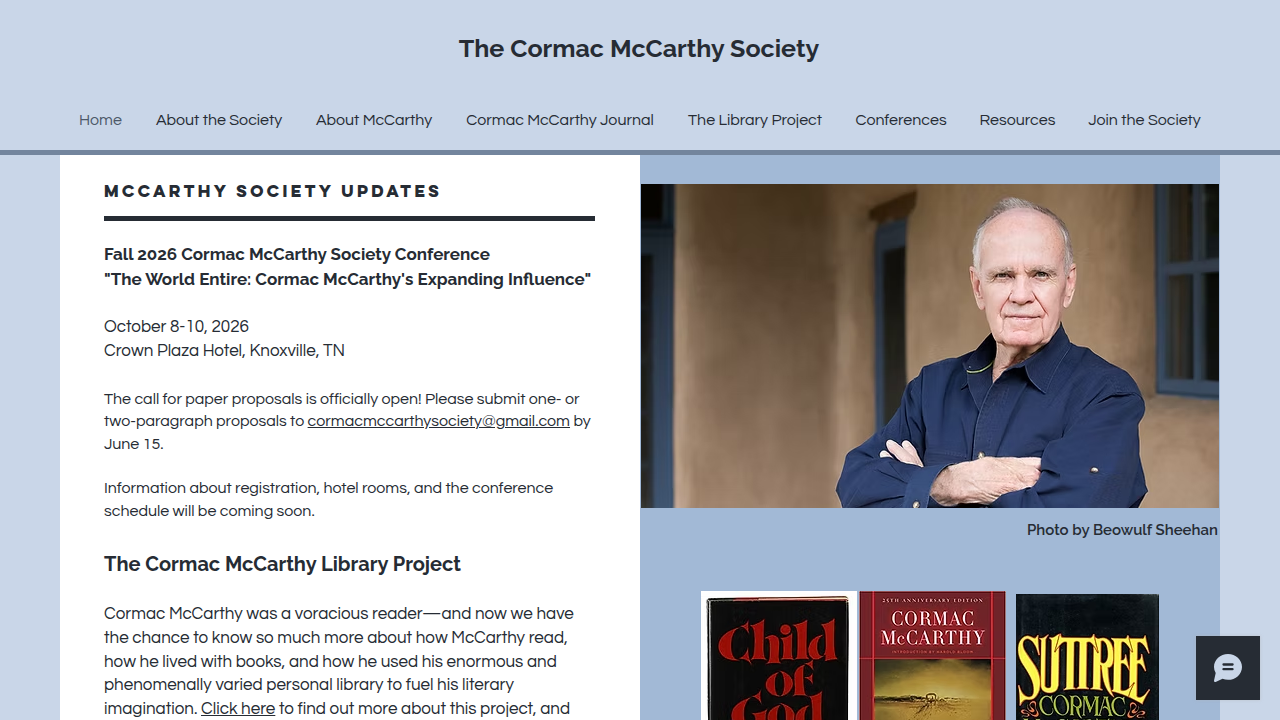
He attended Catholic high school in Knoxville and later went to the University of Tennessee. There, he studied liberal arts and even took classes in physics and engineering, as noted by The Ringer. But he dropped out to join the U.S. Air Force, which sent him to Alaska for a few years.
That mix of Catholic schooling, southern roots, and military discipline shows up all through his writing. His stories feel grounded in real, hard places.
After the Air Force, he returned to Knoxville and started writing seriously. His first novel, "The Orchard Keeper," came out in 1965. It did not sell well. In fact, his early books earned almost nothing. For years, he lived a simple life. Wikipedia notes that he received a MacArthur Fellowship in 1981, which gave him enough money to keep writing without worry.
That kind of dedication changed American literature.

His big break came with "All the Pretty Horses" in 1992. It won the National Book Award and the National Book Critics Circle Award. Then in 2007, "The Road" won the Pulitzer Prize for Fiction. Those two awards alone earned him a permanent spot in the literary hall of fame.
McCarthy passed away in 2023 at the age of 89. But his work lives on. If you want to explore more authors with similar weight and depth, check out our guide to 10 must-read authors in fiction and fantasy. And if his dark world leaves you craving something a little lighter? The Ridiculous might be the perfect palate cleanser.
Early Novels: ‘The Orchard Keeper’ to ‘Suttree’
Even after winning the MacArthur Fellowship, McCarthy did not become a household name with his first novels. When we look at the full catalog of cormac mccarthy books, it is clear these first four are a specific taste. They were dark, dense, and deeply rooted in the Southern Appalachian region. His first four novels are often grouped together as his "Southern period."
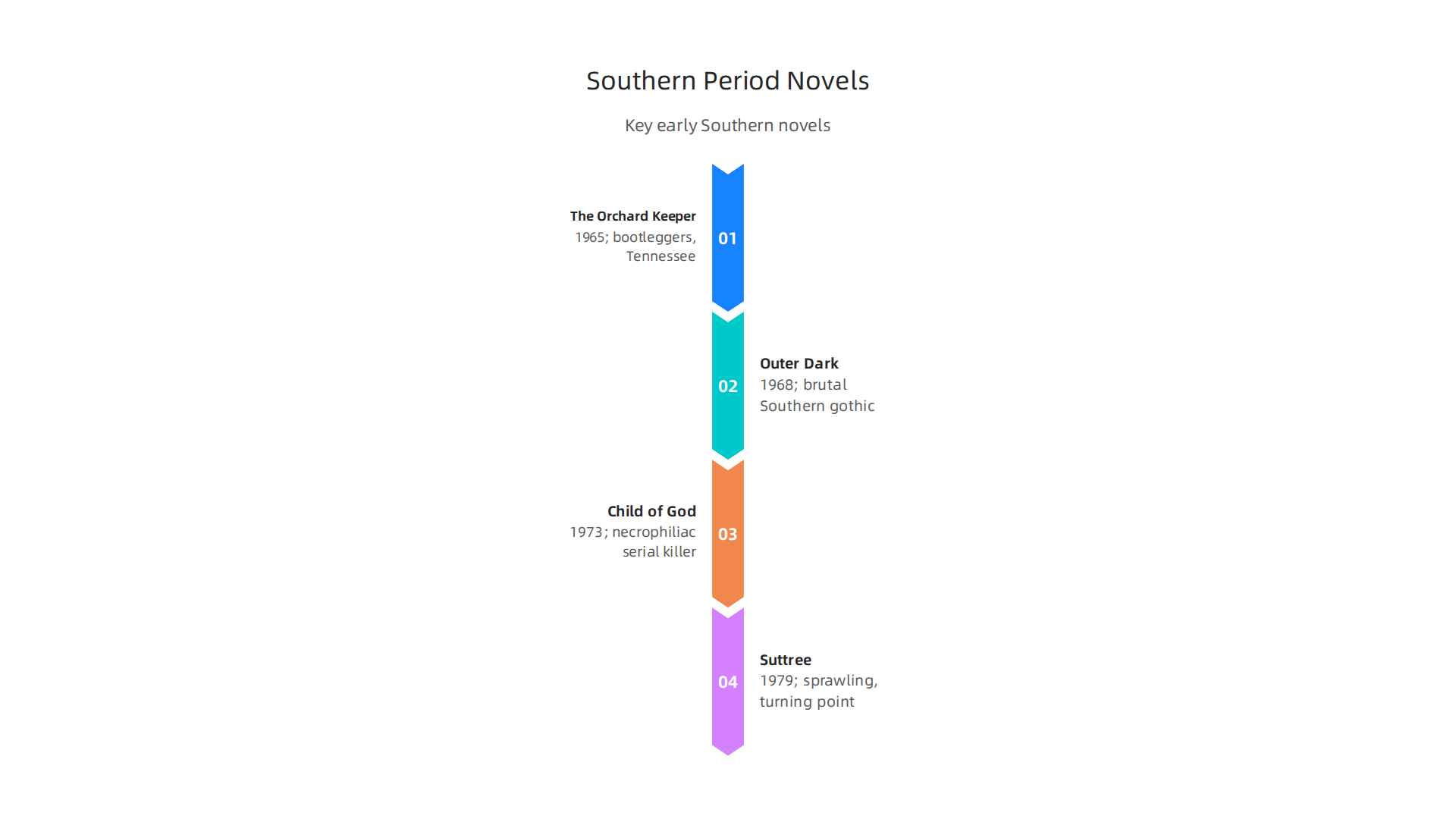
The Orchard Keeper (1965) tells a story of bootleggers and isolation in Tennessee. Outer Dark (1968) is a brutal southern gothic tale of incest and a roving murderer. Child of God (1973) follows a necrophiliac serial killer in the hills of Tennessee. These books were not bestsellers. According to the Cormac McCarthy Society, they were appreciated by a small circle of literary critics who saw echoes of William Faulkner’s complex style.
The influence of Faulkner on these early works is hard to miss. McCarthy used similar long, flowing sentences and a deep focus on the decay of the old South. Themes of brutal violence, the raw power of nature, and men pushed to their absolute limits started appearing here. A Lit Hub article describes his early work as having a "cult of one" following.

Very few people read them, but those who did were devoted. These books are the opposite of something like popular books in the 80s. They were difficult, weird, and not meant for the masses.
Then came Suttree in 1979. This novel was different. It is a massive, sprawling book based on McCarthy’s own time living on the Tennessee River in Knoxville. While it still has the dark humor and violent edges of his earlier work, it feels much deeper and more human. Suttree is often seen as the turning point in his style. The prose here is less Faulkner and more McCarthy. It is cleaner, funnier in a sad way, and more focused on the raw details of life. It paved the way for the completely unique style he used in Blood Meridian.
If you are used to authors like nicholas sparks books, who write hopeful love stories, reading McCarthy’s first four novels can feel like a punch to the gut. His world is gritty and unforgiving. There is very little warmth. But that is exactly what makes him so powerful. He makes you feel the mud, the cold, and the desperation.
If you are looking for a shorter, intense reading experience to test the waters, you might look at the best short novels of all time. But for McCarthy fans, Suttree is often the one they recommend to truly understand his genius. It is the bridge between his raw early style and the masterful storytelling of his later career. If you are ready for a lighter read after all that darkness, check out this list of contemporary writers who will become your next favorite author. Or, if you want a fun escape right now, you might want to try a funny sci-fi series instead. It is a great palate cleanser for imaginative readers.
The Major Themes in Cormac McCarthy’s Novels
By the time you reach Blood Meridian or The Border Trilogy, you start to see the patterns in McCarthy’s writing. His books are built on the same big ideas over and over. If you look at the full catalog of cormac mccarthy books, you will notice three major themes that never leave his pages: violence, the struggle to survive, and the cold presence of fate.
Violence is everywhere in his work. It is not there for shock value. It shows how the world really works. According to an article from Church Life Journal, McCarthy uses violence as a way to show "the founding violence that never ends" in human history. His characters live in a world where danger is always around the corner. Whether you are reading about the brutal deserts in Blood Meridian or the dark hills of Tennessee in his early novels, the threat of death is always close.
Another big theme is fate and the meaning of life. McCarthy’s men are almost always alone. They wander through empty landscapes asking big questions. A research paper on The Borders of Humanity points out that his work is full of "existential themes… including fate, morality and the cyclical nature of time." His characters do not have easy answers. They often face bad choices with no good outcome. That is the point. Life is hard, and McCarthy does not pretend otherwise.
The natural world is also a major character. In both his Southern and Western settings, nature is not a nice place. It is dangerous, wild, and completely indifferent to human suffering. As described in a PDF from Arkansas State University, McCarthy uses the land "particularly Appalachia and the American West" to show how small people really are. The mountains and deserts do not care if you live or die.
So what about morality? McCarthy does not write simple good versus evil stories. His heroes are often flawed. His villains are sometimes wise. He asks hard questions about what it means to be good in a broken world. If you enjoy deep, thoughtful books like this, you might also enjoy our list of timeless classic novels that are the best books to read in 2026.
After diving into all that darkness, you might need a lighter escape. If you want a break from heavy themes, try something fun. Need a New Genre Escape? The Ridiculous mixes comedy, sci-fi, identity, and heart. It is a great way to reset your mind.
The Border Trilogy: ‘All the Pretty Horses’, ‘The Crossing’, and ‘Cities of the Plain’
Even if you need a lighter escape sometimes, you cannot ignore the pull of a masterpiece. The Border Trilogy is the perfect example. It is a central pillar of cormac mccarthy books and a great place to start if you want to understand what all the fuss is about.
The story unfolds over three novels. All the Pretty Horses (1992) follows John Grady Cole, a young cowboy who crosses into Mexico looking for a life that is already disappearing. He finds love and adventure, but also brutal violence. The Crossing (1994) shifts to Billy Parham, a boy who tries to return a wolf to the mountains of Mexico. His journey is lonelier and darker. The final book, Cities of the Plain (1998), brings John Grady and Billy together on a ranch in New Mexico. Their story does not end well.
These books are built on loss. As one analysis puts it, "their central themes concern violence and love and loss, perhaps primarily loss" according to Brett Alan Sanders’ review. John Grady loses his love. Billy loses his family and his wolf. They both lose the world they thought they belonged to. This is a coming-of-age story for the ages, but it is also a goodbye to the mythic West. The border itself works as a powerful metaphor. According to Britannica, it represents the line between the old cowboy code and the modern world crashing in.
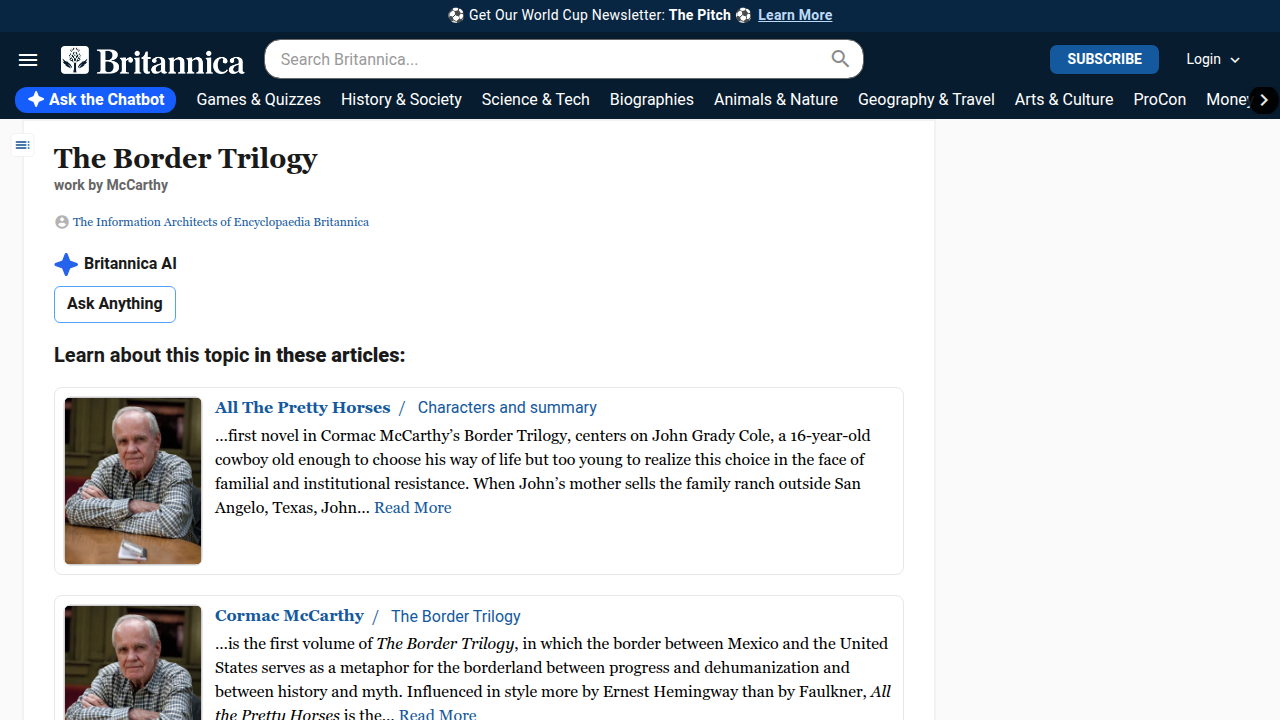
The trilogy was also a huge success. All the Pretty Horses won the National Book Award in 1992. It showed that literary fiction could still sell millions. Fans and critics loved it because it was more romantic and readable than Blood Meridian, while still carrying the same weight. It is widely considered one of the best works of American fiction from the 1990s.
If you enjoy authors who write beautiful, tragic stories, check out our list of 10 Must-Read Authors in Fiction and Fantasy.
The Border Trilogy is heavy, beautiful, and unforgettable. If the weight of it all gets to you, do not worry. There is a perfect palate cleanser waiting. Try a Funny Sci-Fi Series to reset your mind.
‘The Road’ and Post-Apocalyptic Storytelling
From the dusty trails of the Border Trilogy, we move to a world covered in ash. The Road (2006) is McCarthy at his most raw. It won the Pulitzer Prize for Fiction in 2007 and changed how we see post-apocalyptic stories. Wikipedia confirms its place among his most famous works.
The style is the first thing you notice. McCarthy drops most punctuation. Sentences are short and blunt. The language feels burned out, just like the world. This unusual writing style strikes you from the first page. The novel is set after an unnamed disaster, exploring deep psychological and ecological breakdowns according to the SIC Journal analysis. It is one of the best short novels of all time because it says so much with so few words.
But the heart of the book is the father and son. The father calls it "carrying the fire." They keep going even when everything is hopeless. The boy insists on being kind, even when kindness is dangerous. That emotional depth is why readers call it a masterpiece. It is bleak, but it is also a story about love.
If you usually read nicholas sparks books or lighter romance, this will feel heavy. Unlike popular books in the 80s that warned about nuclear war, The Road warns about losing our humanity. It is a classic for a reason. Explore more timeless stories you should read in 2026.
Honestly, this book is a punch to the gut. You will need a break after finishing it. Recharge your mind with something completely different. Try a Funny Sci-Fi Series to lift your spirits and remember that the world is not all ash and cold.
Cormac McCarthy’s Distinctive Writing Style and Prose
If you picked up The Road and thought the writing felt strange at first, you are not alone. That is the point. McCarthy is famous for skipping most punctuation marks. No quotation marks around dialogue. No commas where you expect them. Sentences are short and blunt, like the world he describes.
This unusual style hits you right on the first page. At first it feels like a mistake. But after a few pages, you stop noticing. The stripped-down language matches the stripped-down world. Every word has to earn its place.
His earlier books are different. McCarthy started out with a style closer to William Faulkner. Long, dense sentences. A big vocabulary. But over time, his voice became something entirely his own. By the time he wrote The Road, he had found a rhythm that feels raw and burned out.
One thing that stays the same across all cormac mccarthy books is how he handles landscape. You can feel the cold ash under your feet. You can smell the dust on the trail. He uses geography to show emotion better than most writers use inner monologue.
Dialogue is also a specialty. His characters do not waste words. When a father tells his son to "keep carrying the fire," you know exactly what he means. No explanation needed.
This style is not for everyone. If you usually read nicholas sparks books or lighter romance novels, McCarthy will feel like cold water. He is closer to the best short novels of all time in terms of being tight and meaningful. Unlike many popular books in the 80s that used big action sequences, McCarthy trusts silence to do the work.
If you want to explore other authors who use language in powerful ways, check out our guide to 8 contemporary writers who will become your next favorite author.
But honestly, McCarthy’s stripped-down style can leave you feeling cold. If you need to warm up after living in his world, try a lighter genre. A fun escape can reset your reading mood. Need a New Genre Escape? The Ridiculous mixes comedy, sci-fi, identity, and heart.
Later Works: ‘No Country for Old Men’, ‘The Road’, and ‘The Passenger’
After years of dense, Southern gothic novels, McCarthy took a sharp turn in the late 1990s. He wrote a crime thriller set in 1980s Texas along the Mexican border. That book became No Country for Old Men.
The story follows a hunter who stumbles on a drug deal gone wrong and a suitcase full of money. A ruthless killer named Anton Chigurh chases him. The novel won widespread acclaim and was adapted into a 2007 film by the Coen brothers. The movie won four Oscars, including Best Picture. It introduced McCarthy to an even bigger audience.
Then came The Road in 2006. This book is shorter, tighter, and bleaker than anything he had written. A father and son walk through a burned America. They carry little but each other.

The novel won the Pulitzer Prize for Fiction. Many readers call it one of the best short novels of all time. It sold millions of copies and became a bestseller, far beyond typical literary fiction.
McCarthy did not publish again for sixteen years. Then in 2022, he released two connected novels at once: The Passenger and Stella Maris. These are his final books. They explore grief, family secrets, and big questions about math and physics. The LA Times described him as a "mountain" who shaped a generation of writers. Together, these works rounded out his career with an introspective, almost philosophical finish.
If you need a break from McCarthy’s heavy themes, try something lighter to reset. A funny, warm sci-fi series can be the perfect palate cleanser. Try a Funny Sci-Fi Series and give your imagination a fresh adventure.
For more author recommendations across different styles, check out our guide to 10 must-read authors in fiction and fantasy for your next great book.
Literary Influence and Critical Legacy
Cormac McCarthy didn’t just write great books. He changed how writers think about storytelling. His spare, powerful style and dark themes made him one of the most studied American novelists of the last 50 years.
Many critics compare him to William Faulkner. Both wrote about the brutal side of life in the American South. But McCarthy pushed further. He blended old influences like Beowulf with modern ideas from thinkers like Foucault. His work feels timeless and fresh at the same time.
His impact on the Western genre is huge. Before McCarthy, many westerns were simple good versus bad stories. He showed that the West could be a place for deep questions about violence, fate, and morality. Writers today still borrow his gritty, poetic approach.
McCarthy also reached far beyond books. The film No Country for Old Men won four Oscars and introduced his dark vision to millions. The Road became a major movie too. These adaptations made his name known even among people who don’t read much. He helped prove that literary fiction can have a real place in popular culture.
For many novelists who started writing in the 2000s, McCarthy was a towering figure.

One writer called him "a mountain" that shaped a whole generation. Some found his work inspiring. Others felt crushed by its weight. Either way, you cannot ignore him.
If you want to understand why cormac mccarthy books still matter, start with Blood Meridian or The Road. They show why he is considered one of the best short novels of all time and a master of the American novel.
After reading McCarthy’s heavy work, you might want something lighter. A fun, imaginative story can reset your mind. That is exactly what a new genre escape offers.
Need a New Genre Escape? The Ridiculous mixes comedy, sci-fi, identity, and heart. It is the perfect palate cleanser after a deep literary journey.
For more author recommendations across different styles, check out our guide to 8 contemporary writers who will become your next favorite author.
Film and TV Adaptations of Cormac McCarthy’s Books
Not everyone picks up a book first. Many people meet McCarthy through the movies. And that is a great way to start.
The most famous adaptation is No Country for Old Men. The Coen Brothers took McCarthy’s novel and turned it into a 2007 film that feels just like the book. It is tense, violent, and quiet in all the right places. The character Anton Chigurh became one of the scariest villains in movie history. The film won four Oscars, including Best Picture. Many critics call it the best McCarthy adaptation ever made.
Other books have also been turned into films. The Road came out in 2009. It shows a father and son trying to survive in a broken world. The movie is sad and beautiful, just like the book. All the Pretty Horses reached the screen in 2000 too. Each adaptation tries to capture McCarthy’s poetic but brutal style.
McCarthy’s book Blood Meridian is one of the most popular books in the 80s. Many people still hope someone will turn it into a movie one day. And The Road is often called one of the best short novels of all time. The film version keeps that simple, direct power.
Seeing these films can make you want to read the original books. Or maybe you just need a break from all that heavy feeling. If you want something fun and light next, try a new genre escape.
Need a New Genre Escape? The Ridiculous mixes comedy, sci-fi, identity, and heart. It is the perfect palate cleanser after a deep literary journey.
For more reading ideas across different styles, check out our picks for timeless classic novels worth your time in 2026.
How to Start Reading Cormac McCarthy: A Guide for New Readers
So you want to dive into Cormac McCarthy’s books but do not know where to start. That is normal.
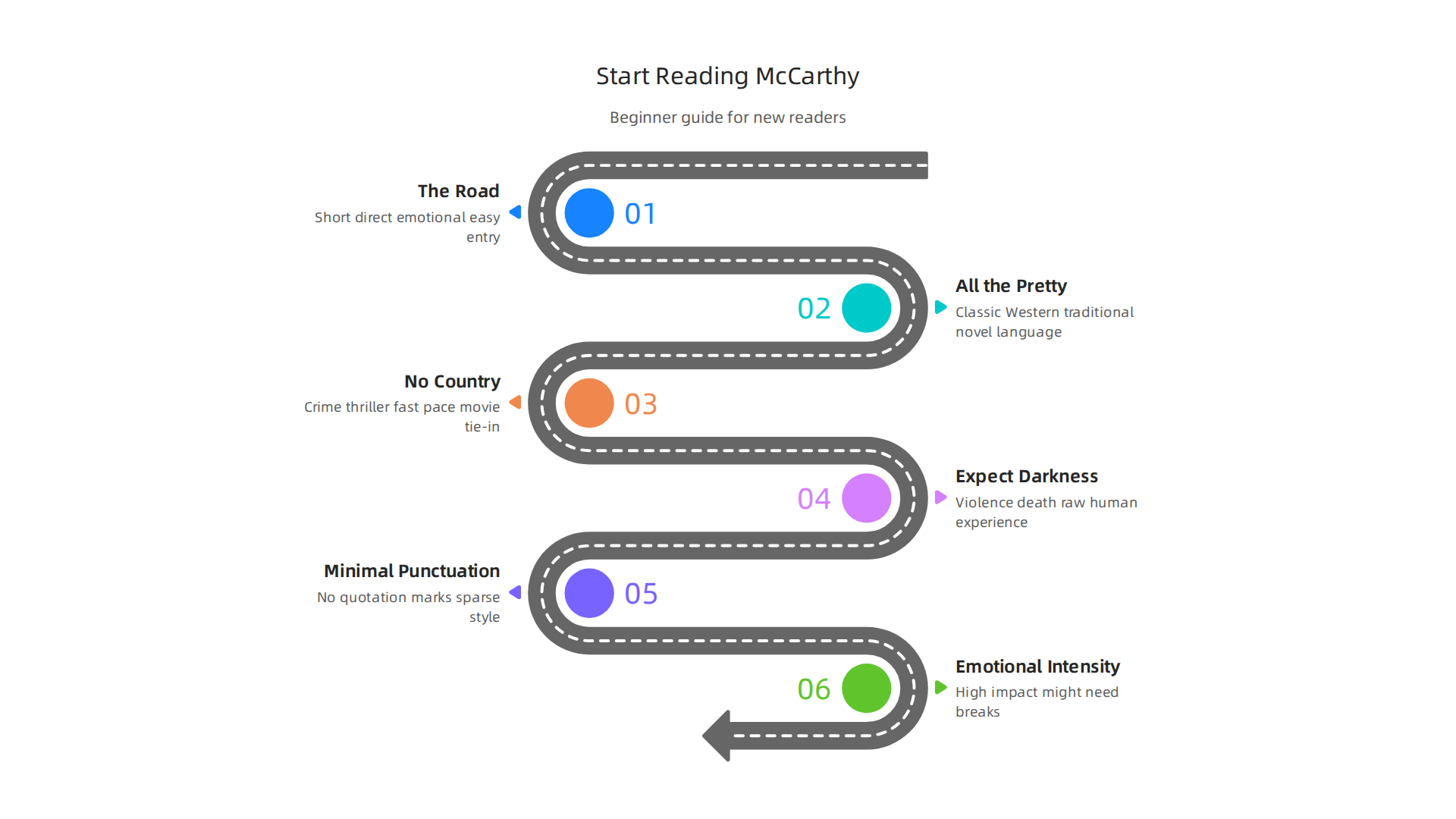
His style is different from what most people expect. But do not worry. With the right plan, you can enjoy his work without feeling lost.
You have two main ways to read his books. The first is chronological order. You start with The Orchard Keeper from 1965 and watch his writing grow over time. This is great if you love seeing an author’s journey. The second way is themed order. You pick books based on what you already enjoy.
If you want an easy entry point, start with The Road. It is short and direct. The story is simple: a father and son travel through a burned world. Many people call it one of the best short novels of all time. The writing is still spare, but the emotion hits hard. Most new readers finish it quickly.
If you love classic Westerns, try All the Pretty Horses. It is a coming-of-age story set in the American West. The language feels more like a traditional novel, but McCarthy’s unique voice is still there.
Another good start is No Country for Old Men. It reads like a crime thriller. The pace is fast, and the movie based on the book won four Oscars. It is a great way to ease into his darker world.
Now, what should you expect? McCarthy’s books are dark. They deal with violence, death, and the hardest parts of being human. He also uses very little punctuation. No quotation marks. No fancy paragraph breaks. At first, this can feel strange. But after a few pages, you will get used to it. The emotional intensity is high. You might need breaks.
One of his most famous books, Blood Meridian, was one of the popular books in the 80s and many people still consider it his masterpiece. But it is also his toughest read. Save it for later.
If you want to follow a reading path like the one we use for other authors, check out our guide on how to read Stephen King books in order. It shows a similar approach for a different writer.
After you finish a heavy McCarthy book, you might need something light. That is when a funny sci-fi series comes in handy. Try a funny sci-fi series that mixes absurd adventures with warmth. It is the perfect palate cleanser.
Start with The Road or All the Pretty Horses, and let McCarthy’s world pull you in.
A Chronological Guide to Cormac McCarthy’s Major Works
Once you know where to start, the next step is understanding how McCarthy’s writing changed over time. His career spans three major eras. Each one feels different.
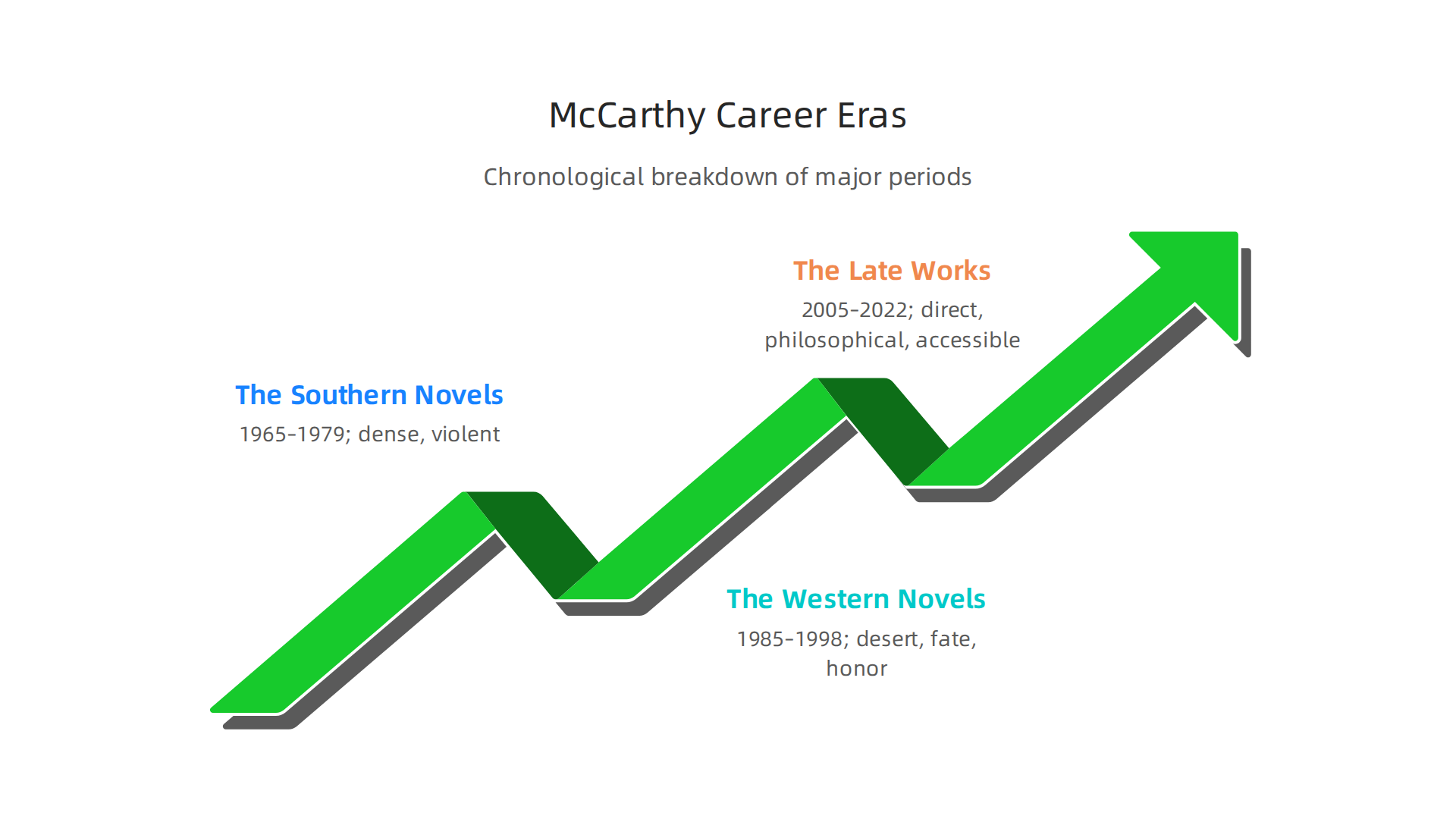
Here is a quick look at each period, with no spoilers.
The Southern Novels (1965–1979)
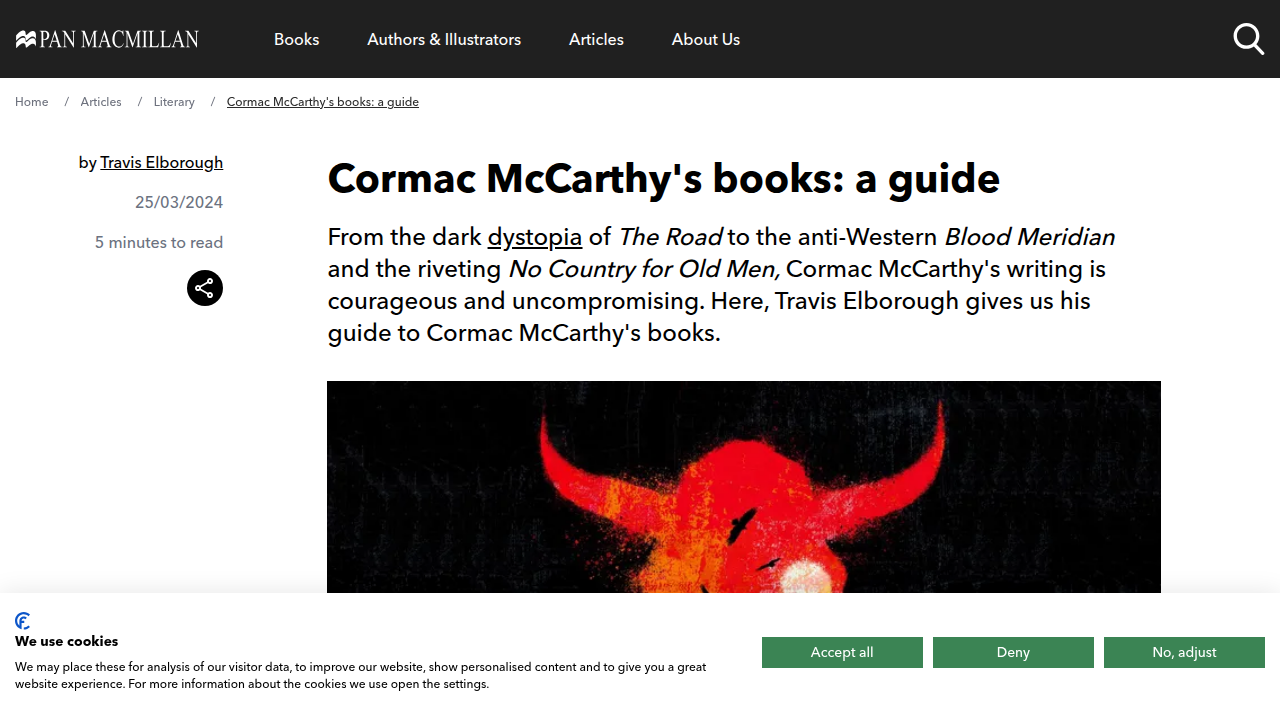
McCarthy started in the American South. This era includes The Orchard Keeper (1965), Outer Dark (1968), Child of God (1973), and Suttree (1979). These books are dense. They focus on isolated characters and strange, violent landscapes. Think rural Tennessee and haunted hollows. The prose is already rich, but it takes patience. If you want the full journey, check the full list of Cormac McCarthy books at Pan Macmillan.
The Western Novels (1985–1998)
McCarthy moved west. This period gave us Blood Meridian (1985), then All the Pretty Horses (1992), The Crossing (1994), and Cities of the Plain (1998). The last three form his Border Trilogy. These books are set in the harsh desert and mountains. They explore themes of fate, violence, and honor. The language gets tighter. Many readers consider this his peak. You can see the full list of works in chronological order on Wikipedia’s bibliography.
The Late Works (2005–2022)
McCarthy returned with shorter, more direct stories. No Country for Old Men (2005) is a thriller. The Road (2006) is a post-apocalyptic father-son journey. His final novels, The Passenger and Stella Maris (both 2022), circle back to earlier themes. These books are more accessible than the Southern works, but they still carry deep weight.
This overview sets the stage. In the subsections below, we will dive deeper into each era. By understanding these phases, you will know exactly what to expect from each book.
After finishing a heavy McCarthy novel, you might want something completely different. If you need a fun break from all that darkness, check out The Ridiculous. It mixes comedy, sci-fi, and heart. It is the perfect palate cleanser.
Summary
This guide explains who Cormac McCarthy was, what makes his novels so powerful, and how to approach his often-dark, spare prose. It covers his life from Tennessee roots to late-career books, highlights major themes like violence, survival, and fate, and shows how landscape and minimal punctuation shape his voice. The article breaks his work into clear periods—the Southern novels, the Western/Border Trilogy, and the late works—and explains why books such as Blood Meridian, All the Pretty Horses, and The Road matter. It also lays out practical reading strategies (chronological or themed), offers entry points for new readers, and reviews key film adaptations that brought his work to wider audiences. Readers will finish knowing which McCarthy books to start with, what to expect stylistically, and how to place his novels in American literary history.